

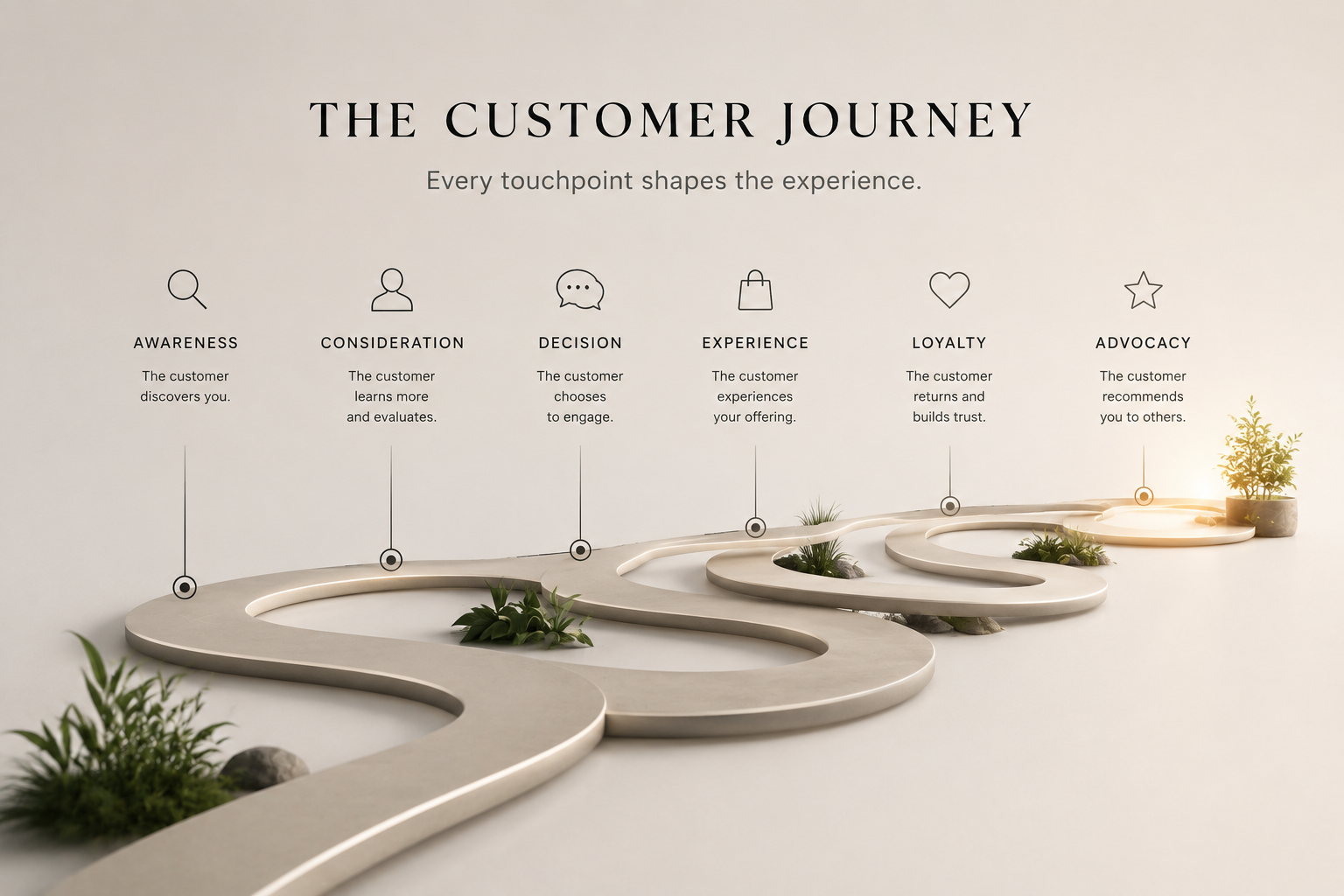
In short: the customer journey starts long before anyone experiences the actual product, the booking process, the welcome, and dozens of tiny unnoticed details compound into either goodwill or friction well before the first mistake ever happens.
The Booking Is Already Part of the Experience
The term “customer journey,” or consumer journey, only came to me for the first time a few years ago. When I went down my usual new-topic rabbit hole, I was blown away by what I had been missing.
Every business should be customer journey mapping regularly, from both a digital and physical standpoint.
Picture two scenarios. Restaurant A and Restaurant B both have great food, service and fit outs, and are priced the same.
At Restaurant A you go to book online. The website is slow and dated, it’s not easy to find the booking widget, and the steps in the booking process are clunky.
You don’t get confirmation of your booking, so you have to call and confirm, and the person on the other end of the phone isn’t overly efficient.
At Restaurant B, their ad pops up in your sponsored posts. The website looks sleek and has great imagery showcasing the brand.
You click book now, and in a couple of easy steps you’ve booked a table. You immediately get a confirmation text with your booking details.
By the time you get to Restaurant A, they are already in a service deficit and now have to make up for the inconvenience of their booking system. Lord knows if your steak is overcooked, you’re not going to be as nice about it.
On the other hand, you weren’t even planning on going to Restaurant B. Because they’ve been smart with marketing, you’re now not only dining there, you’re going in with zero friction from the booking process, and the staff are already set up for success.
What Happens at the Host Stand
When you get to Restaurant A, you arrive at the host stand and look around. The restaurant is busy.
A staff member comes over, warmly greets you and takes you to the table, but you do notice their shoes are pretty scuffed and worn and they clearly haven’t ironed their shirt.
You sit down and they hand you menus. Your menu has some food smudged on it and has a couple of spelling errors.
You notice one of your guests’ place settings is missing a knife.
They say they’ll be back with a drinks menu because it’s busy and they’re short on them. Your server comes over with the drinks menu a few minutes later, and by the time you’ve ordered your first drinks and they arrive at the table, it’s been 20 minutes since you sat down.
Meanwhile at Restaurant B, you arrive to an equally busy restaurant. A staff member greets and seats you in a similar manner, but this time you can tell this person takes pride in their appearance, hair nicely done, crisp uniform, polished shoes.
On the way to the table they ask how your day has been, and you build some rapport with them, mentioning it’s a birthday celebration. They pull your chairs out for you and hand you menus which are nicely designed and formatted.
The place settings are aligned and consistent, and you notice how well polished the cutlery and glasses are.
The host places the drinks menu in the middle, but instead of asking you to read it, they simply ask, “How would you all feel about a bottle of birthday champagne for the table?” You say yes.
They whisk it over, and the person pouring the bottle uses the time it takes to pour each glass to explain the menu.
By the time you’ve sat down, the compounding interest from your customer journey is already massive.
Restaurant A haven’t even done anything too bad yet, but you are already most likely never going to return unless you are suddenly blown away by the most amazing food and service comeback.
At Restaurant B, you’ve already happily spent $25 per person on champagne. You’re excited for what’s to come, and if a staff member drops an entire plate of food on you, you’d probably forgive them.
The Hundreds of Tiny Things You Don’t Notice
You can just imagine how many tiny details are still to come in the customer journey once you get into your dining experience.
Your drinks may be topped up all night without you even noticing, or you might have to wave down a junior who goes and finds your server, who then brings you the wine list, and then your cocktails take 20 minutes.
You could go to the bathroom and there’s music playing, it smells clean, they’ve obviously invested in the décor, and your behind is graced with 3-ply toilet paper.
The alternative I won’t go into details on, in case you’re eating, but let’s just say no one likes giant rolls of 1-ply communist toilet paper, and even less when it’s balled up all over the floors.
There are hundreds of micro moments taking place which you aren’t even aware of, the music volume, the room temperature, the lighting. Even the temperature your food and drink is served at has an optimum enjoyment window, and if it’s delivered to you outside of that, it’s just not as good.
A great bar will never send out a glass with a chip in it. They’ll be checking this before serving the drink, otherwise it gets sent back and they have to throw out both the drink and the glass.
By the time you leave a restaurant, there have been so many little things going on that your brain might be over-stimulated and hasn’t even processed just how good or bad your experience has been yet.
Then you remember that you never once had to ask for more water, that when the shared dishes arrived at the table they had serving cutlery with them, or that the waiter remembered your whole table’s order without writing it down.
If those moments aren’t good, I can guarantee that’s the people who are running to give you a bad Google review the second they get home, even though they said everything was fine in person.
Why This Matters for Every Business
This principle transfers to nearly any business model: ecommerce stores, gyms, day spas, retailers, even B2B businesses. Those moments of friction can compound quickly and lose you a client, member or sale, and just as equally, those moments with great flow can set you up with a business relationship for life.
This is why mystery shoppers and customer journey mapping are so crucial to business. I can guarantee if you get the right person to look, you’ll be amazed at what they find.
Anyway that’s todays observation.
A Question For You
What's a business you've dealt with recently that felt like they had thought of everything?